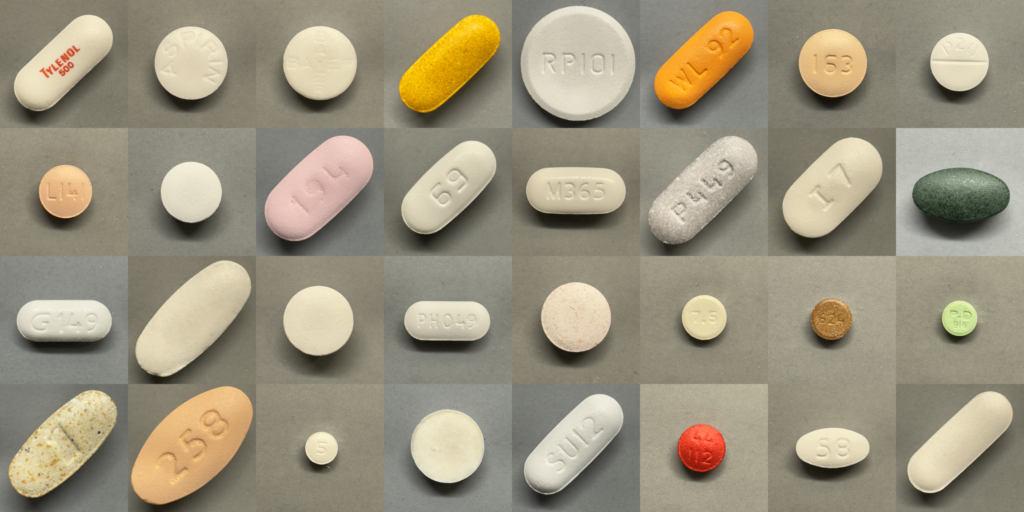
Fighting fake drugs
The World Health Organization estimates that about 1 in 10 medicines in low- and middle-income countries are substandard or falsified, meaning that they do not meet quality standards and specifications. These "fake drugs" endanger patients, waste money, and erode trust in healthcare providers.
The Grover Lab works to develop low-cost, easy-to-use, open-source tools for identifying counterfeit medicines. We are always looking for partners in the fight against fake drugs. If our work aligns with your (or your organization's) priorities, please reach out!
-
Disintegration Fingerprinting: A low-cost and easy-to-use tool for identifying substandard and falsified medicines
Ishmam Fatima, Oscar Fajardo, Canhui Liu, Harshith Sadhu, and William H. Grover, Analytical Chemistry, advance article. Also available as a preprint on medRxiv.
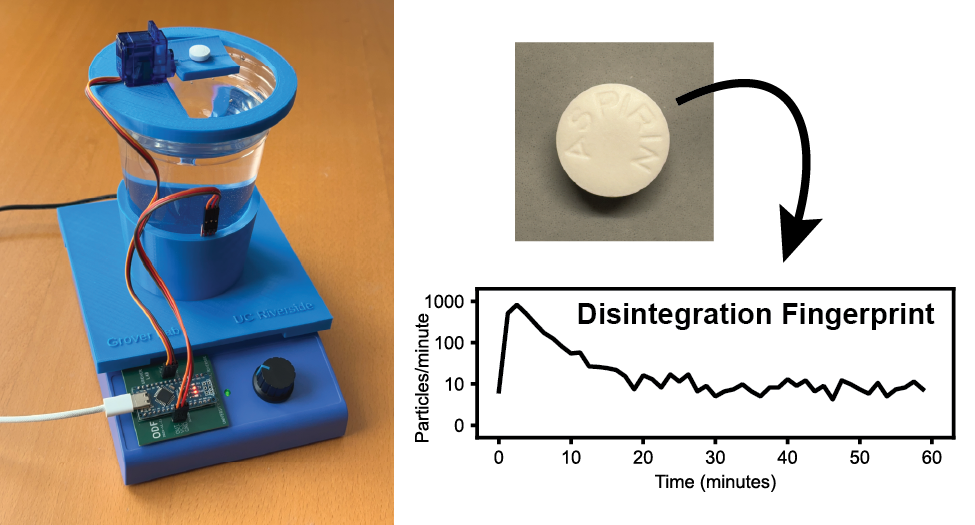
Substandard and falsified medicines cause thousands of deaths and waste billions of dollars worldwide every year. There is an urgent need for low-cost and simple-to-use tools for identifying these “fake drugs.” In this work we demonstrate “Disintegration Fingerprinting” (DF), a technique that identifies pills, tablets, caplets, and other solid-dosage drugs based on how the drug disintegrates and dissolves in liquid. The DF hardware consists of a water-filled transparent plastic cup atop a conventional magnetic stirrer. An inexpensive sensor mounted on the outside of the cup shines infrared light into the cup and measures the amount of light that is reflected back to the sensor. When a pill is added to the stirred water, the pill begins to disintegrate into particles that swirl around inside the cup. Whenever one of these particles passes near the infrared sensor, the particle reflects additional light back to the sensor and creates a millisecond-duration peak in a plot of sensor output versus time. The number of particles in the water changes over time as the particles continue to disintegrate and (for some samples) eventually dissolve away. By plotting the number of particles detected versus time, we create a Disintegration Fingerprint that can be used to identify the drug product. In a proof-of-concept study, we used DF to analyze pills from 32 different drug products (including antibiotics, opioid and non-opioid analgesics, antidepressants, anti-inflammatories, antiemetics, antihistamines, decongestants, muscle relaxants, expectorants, sleep aids, cold medicines, antacids, hormonal birth control, and dietary supplements, as well as a simulated falsified drug product). We found that DF correctly identified 90% of these pills, and the technique can even distinguish name-brand and generic versions of the same drug. Even when testing pills from 33 different manufacturing lots of two similar drug products, purchased in eight different states or provinces in two countries, with manufacturing dates that span almost three years, some of which were intentionally subjected to extreme temperatures (50 °C or −20°C for 35 days), our technique still correctly identified 100% of the pills. By providing a fast (60-minute), inexpensive ($33 USD), and easy-to-use tool for identifying substandard and falsified medicines, Disintegration Fingerprinting can play an important role in the fight against fake drugs.
-
CandyCodes: simple universally unique edible identifiers for confirming the authenticity of pharmaceuticals
William H. Grover, Scientific Reports 12: 7452 (2022)
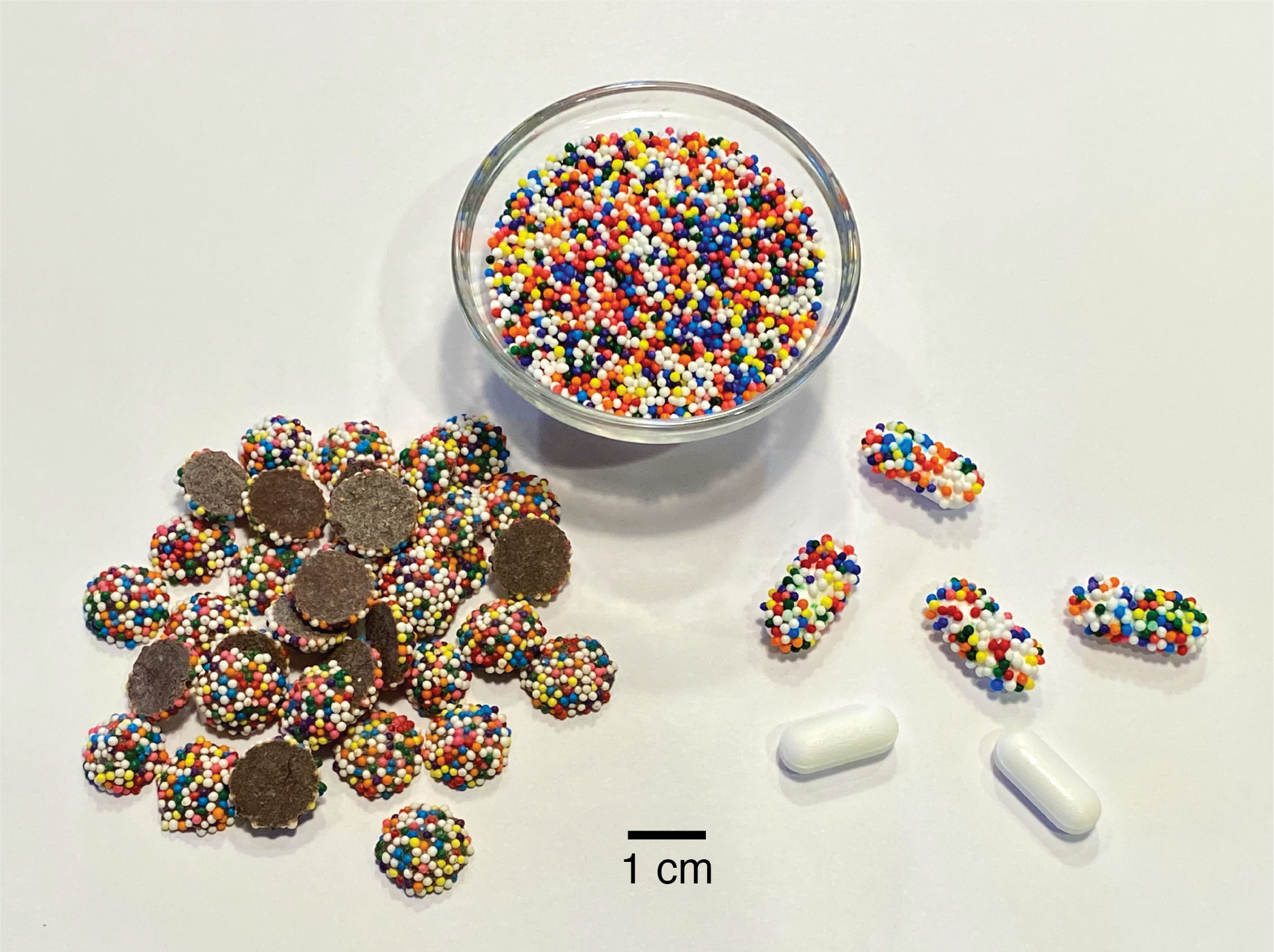
Counterfeit or substandard medicines adversely affect the health of millions of people and cost an estimated $200 billion USD annually. Their burden is greatest in developing countries, where the World Health Organization estimates that one in ten medical products are fake. In this work, I describe a simple addition to the existing drug manufacturing process that imparts an edible universally unique physical identifier to each pill, tablet, capsule, caplet, etc. This technique uses nonpareils (also called sprinkles and “hundreds and thousands”), tiny inexpensive multicolor candy spheres that are normally added to other candies or desserts as decorations. If nonpareils are applied at random to a pill immediately after manufacture, the specific pattern they form is unlikely to ever be repeated by random chance; this means that the pattern (or “CandyCode”) can be used to uniquely identify the pill and distinguish it from all other pills. By taking a photograph of each CandyCoded pill after manufacture and recording the location and color of each nonpareil, a manufacturer can construct a database containing the CandyCodes of all known-authentic pills they produce. A consumer can then simply use a cellphone to photograph a pill and transfer its image to the manufacturer’s server, which determines whether the pill’s CandyCode matches a known-good CandyCode in their database (meaning that the pill is authentic) or does not have a match in the database (in which case the consumer is warned that the pill may be counterfeit and should not be consumed). To demonstrate the feasibility of using random particles as universal identifiers, I performed a series of experiments using both real CandyCodes (on commercially produced chocolate candies) and simulated CandyCodes (generated by software). I also developed a simple method for converting a CandyCode photo to a set of strings for convenient storage and retrieval in a database. Even after subjecting CandyCodes to rough handling to simulate shipping conditions, the CandyCodes were still easily verifiable using a cellphone camera. A manufacturer could produce at least 10^17 CandyCoded pills—41 million for each person on Earth—and still be able to uniquely identify each CandyCode. By providing universally-unique IDs that are easy to manufacture but hard to counterfeit, require no alteration of the existing drug formulation and minimal alteration of the manufacturing process, and need only a cameraphone for verification, CandyCodes could play an important role in the fight against fraud in pharmaceuticals and many other products.
-
Chronoprints: Identifying samples by visualizing how they change over space and time
Brittney A. McKenzie, Jessica Robles-Najar, Eric Duong, Philip Brisk, and William H. Grover, ACS Central Science 5 (4), 589–598 (2019).
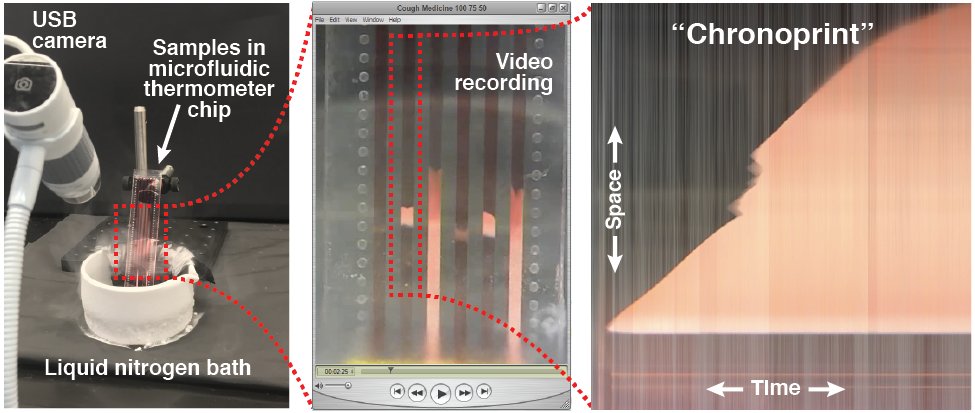
The modern tools of chemistry excel at identifying a sample, but the cost, size, complexity, and power consumption of these instruments often preclude their use in resource-limited settings. In this work, we demonstrate a simple and low-cost method for identifying a sample based on visualizing how the sample changes over space and time in response to a perturbation. Different types of perturbations could be used, and in this proof-of-concept we use a dynamic temperature gradient that rapidly cools different parts of the sample at different rates. We accomplish this by first loading several samples into long parallel channels on a “microfluidic thermometer chip.” We then immerse one end of the chip in liquid nitrogen to create a dynamic temperature gradient along the channels, and we use an inexpensive USB microscope to record a video of how the samples respond to the changing temperature gradient. The video is then converted into several bitmap images (one per sample) that capture each sample’s response to the perturbation in both space (the y-axis; the distance along the dynamic temperature gradient) and time (the x-axis); we call these images “chronological fingerprints” or “chronoprints” of each sample. If two samples’ chronoprints are similar, this suggests that the samples are the same chemical substance or mixture, but if two samples’ chronoprints are significantly different, this proves that the samples are chemically different. Since chronoprints are just bitmap images, they can be compared using a variety of techniques from computer science, and in this work we use three different image comparison algorithms to quantify chronoprint similarity. As a demonstration of the versatility of chronoprints, we use them in three different applications: distinguishing authentic olive oil from adulterated oil (an example of the over $10 billion global problem of food fraud), identifying adulterated or counterfeit medication (which represents around 10% of all medication in low- and middle-income countries), and distinguishing the occasionally-confused pharmaceutical ingredients glycerol and diethylene glycol (whose accidental or intentional substitution has led to hundreds of deaths). The simplicity and versatility of chronoprints should make them valuable analytical tools in a variety of different fields.
-
Musical instruments as sensors
Heran C. Bhakta, Vamsi K. Choday, and William H. Grover. ACS Omega 3 (9), 11026-11032 (2018).
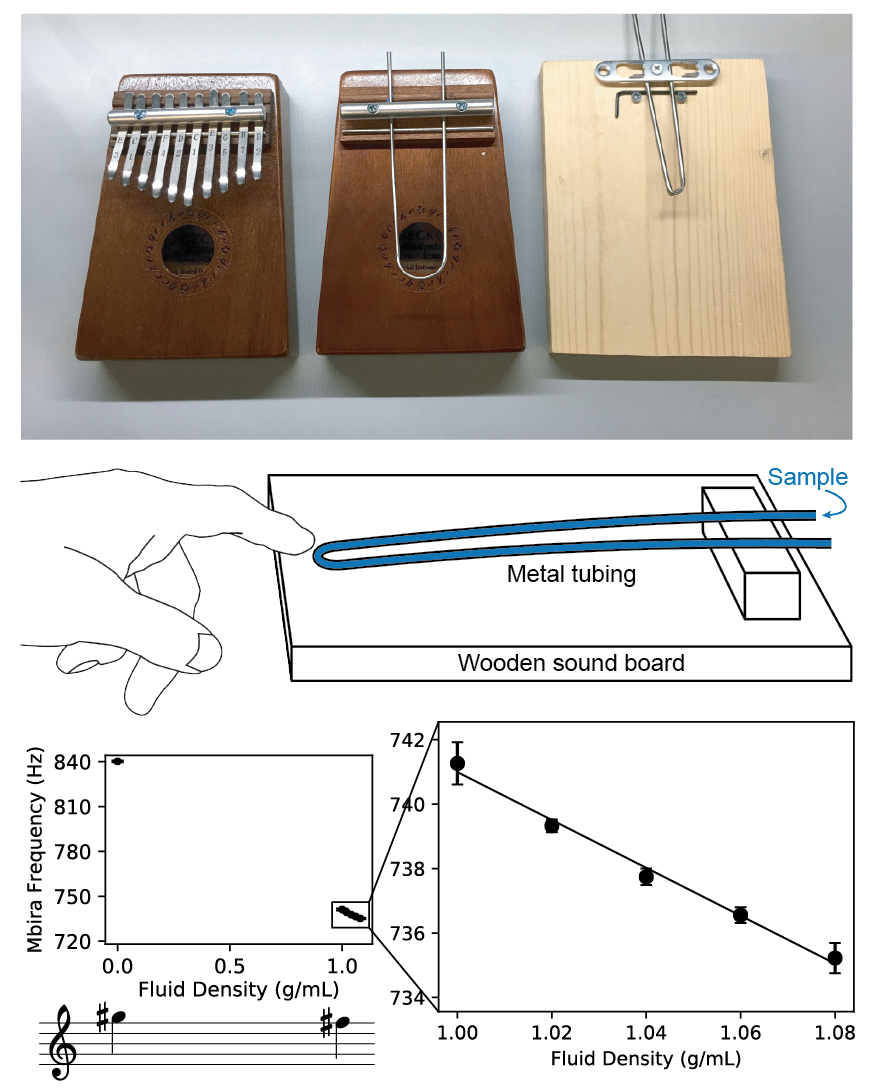
The frequencies of notes made by a musical instrument are determined by the physical properties of the instrument. Consequently, by measuring the frequency of a note, one can infer information about the instrument’s physical properties. In this work, we show that by modifying a musical instrument to contain a sample and analyzing the instrument’s pitch, we can make precision measurements of the physical properties of the sample. We used the mbira, a 3000-year-old African musical instrument that consists of metal tines attached to a wooden board; these tines are plucked to play musical notes. By replacing the mbira’s tines with bent steel tubing, filling the tubing with a sample, using a smartphone to record the sound while plucking the tubing, and measuring the frequency of the sound using a free software tool on our website, we can measure the density of the sample with a resolution of about 0.012 g/mL. Unlike existing tools for measuring density, the mbira sensor can be made and used by virtually anyone in the world. To demonstrate the mbira sensor’s capabilities, we used it to successfully distinguish diethylene glycol and glycerol, two similar chemicals that are sometimes mistaken for each other in pharmaceutical manufacturing (leading to hundreds of deaths). We also show that consumers could use mbira sensors to detect counterfeit and adulterated medications (which represent around 10% of all medications in low- and middle-income countries). We expect that many other musical instruments can function as sensors and find important and lifesaving applications.
subscribe via RSS